

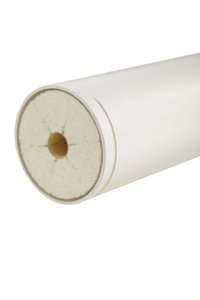
A new type of membrane, partly developed at the University of Twente, can help. This selective membrane is applied to thin porous straws (also referred to as fibres) with holes of about 5 nanometres in diameter (one nanometre is one million times smaller than a millimetre). Multiple thin layers of polymer coating (of about 2 nm thick) are applied over the holes by means of a relatively simple chemical process. A major advantage of the method is that the thin layer can be introduced from water and chemical solvents are therefore not necessary. In addition, the creation of the polymer layers can be controlled very accurately. Depending upon the desired application, the number of layers, the density and the charge of the layers can be chosen.
The new membranes have a number of important advantages. For example, they make it possible to purify water in a single process step, while a pre-treatment step is normally always required in order to filter 'larger substances' from the water. This makes water treatment cheaper and facilitates the use of smaller-scale water treatment plants, so that clean drinking water becomes possible in remote areas of, for example, developing countries. Furthermore, compared to existing hollow fibre membranes, with the new membranes it is easier to remove micro-pollutants such as medicine residues, hormones and pesticides from water.
10,000 Straws
For larger-scale water purification, more than 10,000 of the straws about one metre in length are placed in a module. Anywhere between a few dozens to hundreds of these modules can be installed in a water treatment plant.
On the inside of the straws, the contaminated water flows to the inside. On the outside of the membrane, the clean potable water flows through the fibre, while the contaminants remain behind. It emerged from studies with larger test systems that the method also works well on a large scale. The company Pentair in Enschede, which was closely involved in the research, is taking over the further product development of the membrane.
De Grooth performed his doctoral research at the UT MESA+ research institute Membrane Science & Technology Group. He was assisted with this by prof. dr. ir. Kitty Nijmeijer and dr. ir. Wiebe de Vos. During his doctoral research, De Gooth worked for part of the time at Pentair. This work formed part of a major research platform established for the development of selective hollow fibre membranes and was jointly funded by the European Union through the LbLBRANE research project. De Gooth will defend his doctoral thesis at the University of Twente on 4 February.